Showing posts with label Douglasville. Show all posts

Sunday, September 27, 2015

Douglasville - Bitterly Opposed to the Railroad

I recently ran across an article in "The Southern World, dated October 1, 1883 and titled "The Georgia Pacific Railway".

The sub-headings said, "Facts about the great highway - Atlanta looking for a boom that it would bring."

The article confirms many things I've written before regarding the railroad including how work was actually begun before the Civil War, but the war put the project on hold.

The article provides the year 1854 as the year the Georgia legislature chartered the Georgia Western Railroad Company, and mentions work was done including some grading in Fulton and Cobb Counties, but it was abandoned where it remained at a stand still until 1872-1873.

"Work resumed to meet the fate that compelled so many other enterprises to succumb in that period of panic and business prostration..."

Yes, war has a habit of doing that.

In June, 1881, the Richmond and Danville Extension Company organized in order to complete the rail "highway" construction.  General T.M. Logan was president, Major John W. Johnston was VP/General Manager, Major R.H. Temple as Chief Engineer, G.W. Perkins as Treasurer, and Thomas Seddon as Secretary.

One of the great things this article provides is a description of the land west of Atlanta including the land around early Douglasville before and after the railroad. 

The reporter states, "I shall never forget a trip I made across the country on the line of this road. The country was truly a howling wilderness. Without any means of communication with the outside world except the "pony post". The people seemed to belong to another generation; the few little towns along the line appeared to be falling to decay and a lethargy and indolence to have taken possession of everything and everybody."

But after the railroad?

"Towns have sprung up - little places wakened to new life."

The reporter states he can scarcely realize the places along the "road" are the same as two years before.

Heading out of Atlanta one can see the Chattahoochee Brick Yards eight miles of Atlanta making 100,000 bricks a day.

At Austell, the junction of the ET, Virginia & Georgia and the Georgia Pacific.....it was entirely built within the last eighteen months....now with several stores and is rapidly building up.

At Salt Springs - today's Lithia Springs - just a mere twenty-one miles from Atlanta, the depot was established there on June 14, 1883. The reporter states the little town "now has three stores, a printing press, and a population of about 100. The buildings are neat and the citizens are enterprising to push it ahead."

The information regarding Douglasville is most interesting.

"Douglasville - twenty-seven miles from Atlanta, the county seat of Douglas County, and when the "road" reached this town the population was barely 400."

"Many of the people were bitterly opposed to the road, as they feared on account of quick transportation the business of the adjoining country would seek another outlet. Since the advent of the road the population has doubled, the business has increased in proportion and the old fogy notions are fast dying out."

It's interesting to note the folks in town not only opposed the railroad.....they bitterly opposed it, and some folks here were accused of being old fogies.....In 1883!

"The place now boasts 22 stores, 3 hotels, Baptist, Lutheran, and Methodist Churches, 2 academies, and is indeed a prosperous and thriving place."

"Much of the success of this and other places along the line of the road is due to J.S. James who so ably represents this county in our legislature."

Rest assured, J.S. James was one politician who totally looked out for himself even though he was the linchpin to the city and county's early success.

And don't forget Villa Rica......

The depot there was established and lots sold on August 14, 1882. The depot was built within  a half mile of the old town and the place as grown if by magic. There is a "population of 400, 21 stores, livery stable, 2 hotels, a good school, and a great many buildings in the process of erection."


Friday, September 6, 2013

Douglasville's Birth

Once Douglas County was formed in 1870, a county seat was needed. In fact, the Georgia General Assembly instructed the county commissioners - John M. James, John C. Bowden, W.N. McGouirk, J.H. Winn, and Ephraim Pray - to survey land for a county site and to stake lots for sale. The proceeds from the sale of the lots would go towards building a courthouse and jail.

However, the first order of business was to hold an election for certain offices and allow citizens to choose the location of the county seat. Folks were divided. Some preferred the community of Chapel Hill; others wanted the center of Douglas County, and a third group lobbied for Skint Chestnut to be the county seat.

Many thought it was a foregone conclusion that the Chapel Hill community would be considered. In 1870, Chapel Hill contained a general store and a few other businesses. There was both a Baptist and Methodist church and three different schools. The area was a very prosperous plantation community with several influential citizens.

Some folks wanted the center of the county chosen. It made sense in a way. It would have been an equal distance for all citizens to travel. They decided the geographic center would be the area around Pray's Mill Baptist Church. Supporters promoted the community's water sources - the Dog River and Bear Creek - as the fuel to run industrial concerns.

Many others preferred the area up on the ridge known as Skint Chestnut. It wasn't just the draw of the ancient chestnut tree. The choice had a lot to do with the proposed rail site for the Georgia Western Railroad. The 1870s was a time when attitudes in Georgia were changing. Many of our town father's understood the new "farm to factory movement" which would result in business opportunities, more industrialization, and an established rail line was one of the necessary ingredients.

The commissioners decided on a ballot with just two choices leaving Chapel Hill out. Voters could choose the "center" of the Douglas County or Skint Chestnut. The center of the county received 300 votes, and there were as many votes for Skint Chestnut.

Events took a murky turn when voters ignored the two choices and wrote in other locations. When the votes were counted the board of commissioners arbitrarily ruled that any write-in votes that didn't refer to the "center" of the county would be counted in the Skint Chestnut column. This resulted in a win for Skint Chestnut.

Well, of course the "center" folks weren't too happy. What resulted was a debacle that drug on through the courts for four years with the state legislature finally ordering a second election. During the four years it took for the mess to be straightened out those who wanted Skint Chestnut as the county seat simply proceeded with their plans. Young Vansant donated 40 acres along the ridge for the town. Land lots were laid out, and a small structure was built to serve as a temporary courthouse. County business was conducted including an informal name change from Skint Chestnut to Douglasville.

In 1874, the courts placed the matter back in the lap of the General Assembly, and they directed Douglas County Commissioners to hold a second election except this time they directed that the two choices for county seat should be along the proposed railroad route.

Voters could choose between Skint Chestnut/Douglasville where county business had been transacted for the past four years, or they could vote for Rueben Vansant crossroads, a spot further up the rail line about 3 miles. Basically, it's where today's Bright Star Road and Bankhead Highway intersect.

Naturally, the Skint Chestnut site won, and the General Assembly formally established the town on February 25, 1875.

The rest we can safely say is history.

This post first appeared in the Douglas County Sentinel on April 24, 2013.

Tuesday, July 30, 2013

At Auction: Douglasville Property


The following ad appeared in "The Atlanta Constitution" during March, April and May, 1874.

Will be sold to the highest bidder, on the premises at 10 o'clock a.m., on Wednesday the 27th day of May, 1874, a part or all, of one hundred and thirty-three lots as numbered and defined in the plat of the town of Douglasville, the county site of Douglas.

The property has been donated to the county by Mr. Young Vansant, and will be sold with a view to the commencement of the public building.

32 of these lots front the courthouse square and the others extend back, making very desirable lots for businesses and private residences.

This property is located on the Georgia Western railroad, 27 miles west of Atlanta.

Douglasville, the county site of Douglas is destined at no distant day to be one of the most flourishing towns in Georgia.

Terms: Five percent, cash, the balance divided into two payments, one-half to be paid November 1, 1874, the remaining half, November 1st, 1875. Purchase money secured by lien on property sold.

John M. James, Ordinary

E. Pray, J.C. Bowden, W.N. Magouirk, J.H. Winn - Commissioners

Sunday, January 29, 2012

The Man Who Designed Courthouses


I have  been in love with small town courthouses since I was a little girl.   I love the similarities and differences in architecture, I love the stories regarding the folks who worked in the building, the records the building holds and the life and death decisions made in them, and I love the attention the building garners just because it’s in the middle of town.  

Simply put,,.. in my opinion …courthouses make a town

Wilbur W. Caldwell states it best in his book The Courthouse and the Depot:  The Architecture of Hope in an Age of Despair when he states, “Courthouses, more than any other building of the era [between 1870 and 1910] symbolize the aspirations and the collective self-image of the people of these towns.”

Caldwell continues, “Architecture supplies us with a direct conduit to the spirit  of the past….These structures sing to us in rhythms of hope and pride and sweat, dirges of ruin and failure and dashed dreams, anthems of triumph, broken waltzes of irony.  In short they sing for us the music of history.”

The music of history? 

Yes!   I certainly believe they do, and while we have a wonderful Douglas County Courthouse on Hospital Drive and the 1956 Courthouse was preserved as a museum for county history I still mourn for the loss of our 1896 Courthouse.  


Douglas County Courthouse, 1896.   Burned 1956.
Yes, I never walked through its hallways, never had any county business to conduct there, I was never even able to drive by the building since it burned in 1956, but I mourn for it.   I wish the grand old building still graced our courthouse square in the downtown commercial district, and I often wonder how different things might be.

Earlier this week when I was perusing through my pages and pages of notes I have regarding Douglas County history my eyes lingered on one paragraph.   I had written, “The arrival of the Georgia Pacific Railroad in 1882 brought the usual clamor regarding a new courthouse.  In 1884, the Grand Jury suggested that the old courthouse, which was only a few years old, ‘was in bad shape and perhaps dangerous’ and recommended that the building be ‘bolted and banded without delay.’   Local legend holds that the bricks for the building had been improperly fire, some say owing to alcohol induced negligence on the park of the local brick maker…It would be twelve years before Andrew Bryan’s new courthouse finally rose.”

Andrew Bryan.   I’d never really paid much attention to the name.   I wondered to myself who he was.

Hmmm…..it’s always the little things that grab my attention and send me down the rabbit hole most folks refer to as research.    I spent about twelve hours trying to find everything I could about Mr. Bryan.

I’ve actually found quite a bit about the man who designed Douglas County’s 1896 courthouse….sometimes referred to as Andrew J. Bryan & Co. or Andrew J. Bryan, or even Andrew Jackson Bryan.  I’ve found courthouse records that state he was from Atlanta, Missouri, New Orleans, Jackson, Mississippi and then I finally tracked him to Chico, California……I think.

Let’s just say that Mr. Bryan was a busy architect and got around after he was born in 1848 in Monroe, Missouri. 
    
Besides designing our 1896 courthouse here in Douglas County he designed several others around the state as well as buildings all across the South.   Unfortunately, like our own 1896 Courthouse many of the examples of Mr. Bryan’s designs succumbed to fire, but thankfully I found some old photos.

One of the earliest mentions of A.J. Bryan was found in the History of Butte County by George Campbell Mansfield regarding the history of Chico, California.   Mansfield states  A.J. Bryan was on the city council for Chico February 3, 1886 through 1890 when he resigned.   Perhaps he resigned because he knew he would be out of town often checking on the construction of his designs.

While serving on the Chico City Council Bryan designed and served as the supervising contractor for the Normal School on the campus of Chico University in September, 1887. Per this website the building was a large brick building, consisting of three stories and full basement.  It was of Romanesque design with Elizabethan gables and artificial stone trimmings…On August 12, 1927 fire destroyed the building leaving only a skeleton of brick walls. 

Debra Moon in Chico:  Life and Times of a City of Fortune advises “The location of the Normal School Teachers College in Chico was a consolation prize for the citizenry who had worked so hard on the county seat issue.   A group of 15 prominent citizens from Chico went to work to convince the legislators to choose Chico including [Mr. Bryan].”  Today, Chico University is California State University.


Chico University's Normal School, 1887
Caldwell advises A.J. Bryan designed at least eight courthouses in Georgia proving himself to be a versatile innovator on varied projects. The Douglas County Courthouse was one of his earliest projects in Georgia along with the Stewart County Courthouse in 1895 located in Lumpkin, Georgia.   It was destroyed by fire in 1922.
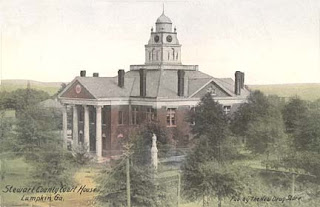
Stewart County Courthouse, 1895
A.J. Bryan also designed the Muscogee County Courthouse in 1895.   Per Caldwell, “The up-to-date styling of Bryan’s design at Columbus points directly to a remarkably progressive spirit in that city.    The architectural style of court buildings of this period were driven more by local hopes and attitudes than it was by the artistic tastes and convictions of the architects who designed them.”  The building survived until 1972 when the building was demolished.

Apparently Mr. Bryan was applying to design courthouses all over Georgia.  American Architect and Architecture for October 3, 1896 advised Bryan’s company had plans to build a new courthouse in McDonough, Georgia.  A month later The Henry County Weekly advised Bryan had been employed to inspect the old courthouse, but apparently his designs didn’t meet their expectations since another architect by the name of James Golucke got the Henry County nod.

Engineering News-Record in January, 1897 advised Bryan had designed the new courthouse in Randolph County, Alabama located in Wedowee.    Sadly that building was destroyed by fire in 1940.   It had so much more character that the Randolph County Courthouse does today.

A.J. Bryan was creating a name for himself.  He was mentioned in the Atlanta paper, The Constitution, in 1897.   The paper advised Bryan’s work was confined almost exclusively to courthouses and other public buildings throughout the southern states, and that the firm had plans for a number of county courthouses throughout Georgia in hand and would deliverer them within the next few weeks…as soon as the weather will permit. 

The year 1900 saw the courthouse in Coffee County completed, but like the others it no longer survives.  It was destroyed by fire in 1938.


Coffee County Courthouse, 1900
The Colquitt County Courthouse at Moultrie followed in 1903 and he also designed the Troup County Courthouse in 1904.   Over 600,000 bricks from Trimble Brick Company of Hogansville were used to build Bryan’s design in LaGrange.

In 1936, the building caught fire.   Two women died.   Few records were destroyed in the fire, however, because citizens formed a line and passed the documents and docket books from one to the other until most of the papers were removed from the building.


Colquitt County Courthouse, 1903

Troup County Courthouse, 1904
A.J. Bryan also designed the Monroe County Courthouse in Alabama.  Many experts state the design is very similar to the Troup County Courthouse.     Per the Encyclopedia of Alabama:  The courthouse’s most significant claim to fame is its inspiration for the fictional courthouse in Harper Lee’s novel To Kill a Mockingbird…None of the film was shot in the courthouse, but the film set constructed for the courtroom scenes was patterned after the building’s unique oval courtroom.  Although the cost of the building nearly bankrupted the county, the structure was finished and in use in 1904. 

In 1906, Mr. Bryan also designed a Carnegie Library near Chico, California.   This website states the Biggs Public Library located in Butte County, California was designed by Mr. Bryan and opened in 1908.   The site further states, “When the Carnegie grant of $5,000 was offered in 1906, Biggs may have been the smallest city to undertake the responsibility of a library grant.  

It wasn’t an easy road.  The library site advises construction was delayed by the high cost of labor following the ‘San Francisco fire and railroad congestion’ after the 1906 earthquake.


Summerville, Georgia welcomed Mr. Bryan in 1909 as he designed the Chattooga County courthouse.  It’s one of my favorites.  

Chattooga County Courthouse, 1909
Back closer to him home in Chico Bryan designed the Chico City Hall in 1911, and a historical inventory of buildings I found online here and   here states he designed at least four homes which are all similar.  There is no question one of the homes was designed by Bryan as his signature was found on one of the boards.


I’m sure you have already noted the similarity in the homes.  They all use segmented intersecting gambrels, columned enclosed porches, and accent shingles that makes them immediately identifiable. Sadly, Mr. Bryan’s home was mentioned in the inventory, but not photographed.   Apparently the home had been altered to such an extent it was not included.

A.J. Bryan passed away in 1921.  Western Architect and Engineer mentions Bryan’s death saying…..”in the death of Mr. A.J. Bryan of Chico, Butte County, on October 10, the Architect and Engineer lost one of its oldest readers, Mr. Bryan having been a continuous subscriber to this magazine since its first number in 1905.   Mr. Bryan’s death was due to paralysis following an illness that extended over a period of nearly a year.   He was 73 years old.”

Bryan’s grave can be seen here.

If you want to learn more about Georgia’s various courthouses this site is invaluable.    A tour of the various courthouses that can be found along Georgia 27 can be found here.   Georgia’s Historic Preservation Division can be found here along with an online manual regarding courthouses.

Thursday, January 12, 2012

Here's O'Neal Plaza


In 1969, William H. Whyte was helping the City of New York with urban planning by studying human behavior in urban settings. Over a span of 16 years he conducted the Street Life Project to understand how people use city spaces. As unobtrusively as possible, he watched people and used time-lapse photography to chart the meanderings of pedestrians. What emerged through his intuitive analysis is an extremely human, view of what is staggeringly obvious about people’s behavior in public spaces, but seemingly invisible to the unobservant.

Mayoral Candidates Q & A


Editor's Note: In just a few short days, the city of Douglasville will elect the 40th person to hold the office of nayor since the first city election held in March 1875. The candidates for mayor—Terry MillerHarvey PersonsRochelle Robinson andRon Wilson—have been meeting with citizens and making appearances at various forums to answer questions and explain their position regarding the issues. Douglasville Patch had some Q&A time with them as well.
1. Lifelong residents of Douglasville have seen the city limits expand as areas like Thornton Road, Kroger at Chapel Hill, and Tributary were incorporated. What can be done to help downtown residents and citizens in these incorporated areas feel as if they are all in the same city?
Terry Miller: We must make sure that our signage is consistent throughout the city, and that services are provided at the same level in every incorporated area. Also, our city leaders should make the effort to participate in town hall meetings in each Douglasville neighborhood.
Harvey Persons: Our city has grown over the years and we need a mayor that will work to help all of our citizens feel that they are a part of one community. I will do several things to help each area of our community feel connected as one. We will start with Town Hall meetings to listen to the thoughts, needs, and ideas of our citizens. This will allow City Hall to better respond to the needs of our citizens. We will make better use of technology and communicate with our citizens to let them know what is going on in all areas of our community. This exchange of information and communications will help foster a better sense of community and oneness of purpose.

Wednesday, January 11, 2012

Make Your Mark


It’s rare to find someone content with passing through life quietly.  Most people want to leave behind a legacy–some sort of proof they were here and their life mattered.  The character Brooks in Stephen King’s "Shawshank Redemption" comes to mind. After serving more than 40 years in prison an elderly Brooks is paroled, but can’t seem to make it in the real world. He takes his own life, but before doing so he feels he must make his mark on the world by scrawling “Brooks was here” on the wall. 
Yes, making our mark seems to be so very important to humans.
Today it seems we have many different ways to make our mark just to say, “Hey!  I’m here.” These are ways that can be argued as being negative or positive depending on your point of view. We have vanity plates for our cars; people earn a particular status for what they do or say, and for what they wear. People become notable just for being on a reality show, we can have a blog, a website, and it’s not totally lost on me that we make our mark by having a Facebook profile. We can even make our mark anonymously by donating to charity, working behind the scenes for a needy family, or even invent a screen name to post anonymously on a message board. 

Douglasville History Is a Big Deal


I had someone the other day ask me why I waste my time writing about Douglasville history since nothing of any value ever happened here. 
Yes, that person is still in an upright position and walking around, but I did briefly think about smacking them. 
I let the person continue with their statements, and they actually made a few decent points arguing that on the whole Douglasville and Douglas County has made a pretty good practice of allowing our local history to be demolished, thrown away, neglected, and forgotten, but then he spouted some more fighting words stating state and local history was irrelevant since most folks grow up and move away. Why teach it?  We don’t use it. 
You never really need local history later in life, right?
I’m glad curriculum experts across the country don’t follow that way of thinking. If they did I would have never been taught any Geometry. I can state emphatically I have never had to solve a geometric proof in any of the three careers I’ve had since my teen years. Throw out the reading of Poe, Melville, and Whitman because students who might grow up to be policemen really have no use for early American literature. Perhaps we should delete teaching students Linnaean Taxonomy because very few ever have to know the species, genus, or family of every animal they encounter.

Taking a Minute for the Masons


I hope you are having a great Labor Day so far. Today we tend to think of the day as summer’s last hurrah with one more trip to the
beach, barbeques, and parades, but there’s more to it. 
Early citizens of Douglasville would have known about the meaning behind Labor Day since it became a federal holiday in 1894, but it
would be a few years before labor unrest touched Douglas County.  The passage of legislation creating the official holiday was a political overture by President Grover Cleveland’s administration. They were responding to public outcry after the U.S. military and U.S. Marshall’s fired upon workers during the Pullman Strike killing thirteen and wounding fifty-seven.  The legislation creating Labor Day passed unanimously to reconcile the government and labor. 
As I put this column together there is talk that the 48th annual Labor Day parade sponsored by theSweetwater Shrine Club might be rained out. I know we need the rain, but it would be the first time the Shriners would fail to lead the parade down Broad Street since 1958. 

Discover Downtown's Corner Bank


You can’t help but notice the building if you get caught by the red light at the intersection of Campbellton and Broad Streets in downtown Douglasville. The tile work showcasing the business name, the little architectural flourishes that make the building so unique and the exquisite round and fan windows all boasting imported German glass takes you back to another time.
I’m speaking of the beautiful Farmers and Merchants Bank building, of course. The location happens to be the original home to the second bank organized in Douglasville. 

Demolition By Neglect

This past week I performed a little experiment. I threw the word "history" out to various people - friends, waitresses, store clerks, even a couple of surprised strangers - and asked them to tell me what immediately popped into their minds.

Various words were thrown back to me - events, dates, maps, wars, battles - and the list goes on.

None of the responses really surprised me, but there are other words to parallel with the word history. Words like preservation, remember, and trust come to mind and unfortunately, the words failure, greed, demolish, surrender, neglect, and ignore are on the flipside as I continue examining the winding path of history our cotton mill in Douglasville has taken.

I shared the story last week regarding how Douglasville ended up with the cotton mill and how important the mill was to our economic health over most of the last century. You can see my column form last week here.

Now I want to share the rest of the story regarding how history can be neglected and forgotten by the very people we trust to preserve it. Sometimes in their attempts to improve the lives of citizens in the here and now they actually betray the trust handed to them by citizens who lived their lives a long time ago. They also end up cheating future generations regarding our historical records.

History can also be used by folks who are just looking for easy outs in business in order to leverage property or satisfy some misguided need to collect historic properties, and then allow them to die a slow death of neglect for some strange reason I simply cannot fathom.

It's a shame that a unique and proud cotton mill with such a rich history ended up as a sad and lonely piece of Douglasville history slated to be sold on the courthouse steps in just a few days.

Construction for the mill began in 1897 and over the years mill housing was built for employees. The mill village also included a company store, athletic fields, and churches. In 1934, the mill was involved in the Textile Worker's Strike of 1934, the larges labor strike in the history of the United States, with over 44,000 mill workers across Georgia on strike regarding various issues of discrimination and evictions. In 1953, sources indicate the cotton mill was Douglasville's largest employer with 3,000 workers or one-fourth of the country's population.

It was during the late 1990s that the Douglasville Historic Preservation Commission and Douglasville City government became involved with the cotton mill property due to a proposed widening project for Bankhead Highway that is still on hold to this day. In case you aren't aware when the Georgia Department of Transportation or GDOT wants to make any changes regarding our roads they have to conduct various studies including one that determines how any historic sites in the proposed area will be impacted by the road changes.

At first all GDOT did was a quick assessment referred to in a later document as a "windshield survey" meaning they didn't even get out of the car. An article published in the Cultural Resource Management magazine presented by the National Parks Service indicates, "Local historians were unaware of the patented design for the mill in...Douglasville, Georgia," and since the windows had been bricked in "the mill in Douglasville was deceptive in appearance causing it to be overlooked [initially] in a [GDOT] survey of historic resources."

On November 13, 1997, the United States Department of the Interior issued a letter to the Georgia Department of Natural Resources, Historic Preservation Division noting GDOT had not designated the cotton mill as historic and sited their own research DID indicate the structure had historic value even though it had been "altered on the exterior." The letter further stated, "This mill IS certainly worthy of additional examinations."

Finally, on January 30, 1998 officials with GDOT, the city of Douglasville, as well as officials from the Georgia Historic Preservation Division met and all were in agreement the cotton mill site was eligible for listing on the National Register of Historic Places under Criterion C for its distinctive method of construction.

Now, here is where I need to make a clarification. The agreement between all of the government entities regarding historic status does not mean the property was automatically protected. Anyone can fill out the paperwork and nominate a site for National Register status, but the owner of the property can turn it down.

Yes, it can't be forgotten that during all of the to and fro between all of the governmental agencies and officials the mill property was privately owned. The wrangling over historical status merely had to do with the GDOT project and the hoops they are required to jump through when trying to get a project off the ground. During the initial wrangling over historic status the mill property was owned by Kenneth Farmer and then in August, 1999 the property was transferred to Fellowship Christian Center, Inc.

If the Bankhead widening project had happened the way it was initially proposed the outside wall of the mill would have had to be removed if not the entire structure, so of course the entire structure had to be fully examined. The widening project could have been very beneficial to the property owner as a selling point, but historical status could hinder GDOT with their plans as they were.

Eight months prior to Fellowship Christian taking over the property the Douglasville Historic Preservation Commission prepared a document titled "Report for Nomination: Proposal for Historic Designation Georgia Western Cotton Mill" containing the information noted above. In fact, I've been told the cotton mill was one of the first properties the commission identified formally as a historic site.

Sadly though, I have been advised the City Council pressed the commission to remove the listing a couple of years ago after being convinced by a developer that the historic designation limited development options. Rather than take steps to prevent deterioration an market the property as an asset, the mayor and council for all intents and purposes promoted its demise.

An undated letter from the City of Douglasville to the Douglasville Historic Preservation Commission requests the commission to remove the cotton mill property from the local historic registry. The letter advises "the buildings are in a state of disrepair and it is unlikely they can be returned to a state of historic significance."


I have a problem with that. Historical significance does NOT disappear simply because a site is not in pristine condition.

The letter goes on to state, "The buildings are unsafe to occupy and are a hazard to the community. We need to pursue condemnation procedures and are unable to do so due to its historic affiliation."

First, it bothers me that the letter is not dated. Second, it bothers me that if condemnation was on the city's mind why has the property not been condemned? It seems to me the "historical status" of the property was the hindrance.

Inman Park Properties took ownership of the mill property in 2001, and here is where the ride gets even bumpier.

Let me introduce you to Jeff Notrica, the person at the helm of Inman Park Properties, hereafter referred to as IPP. Do a quick look across the web and you can quickly see several adjectives that describe Notrica - businessman, property developer, landlord, deadbeat, slumlord, scum of the earth, innkeeper, crook, and hoarder.

Under the guise of IPP and various other LLC businesses Notrica spent the 1990s and the first few years of the last decade buying up property after property in Atlanta, Birmingham, and Savannah.

As I continued with my research I noticed a patter. The majority of the properties IPP acquired were interesting or significant in some way. IPP acquired the properties and generally did nothing to improve them even if they had tenants. Apparently IPP charged high rents, but the buildings were in poor shape and remained that way so they could be tax write-offs. In some cases IPP even told prospective tenants THEY had to pay for property upgrades. Then of course, IPP would take out mortgages on each property for up to four times the actual value of the property. The borrowed money would fund the purchase of more properties, and the process would begin anew.

For example, IPP bought the Gordon School property in the East Atlanta Village for $200,000 and then placed more than $4 million in debt against it. Improvements? No, at one point there were trees growing on the second floor of the structure.

There was also a small parking lot in IPP's portfolio bought for $127,000, but was quickly mortgaged for $600,000. Guess there was yet another historic property for IPP to snap up.

The whole business model (if you really want to call it that) harkens to one of those late night infomercials where the announcer repeatedly tells you, "Yes! You too can get rich quick in real estate!"

For our own cotton mill property was purchased by IPP for $195,000 in 2001. In November, 2004 a mortgage was issued from Omni Bank (it has since been assigned to another company) for $1.2 million dollars. Was the money used to improve the mill property? No. You can take a look at my pictures here and determine for yourself.

Of course, during the time IPP has owned the cotton mill property the property taxes have run behind. The last delinquency is for 2008, 2009, and 2010 leading to a sheriff's sale.

The now defunct website for IPP stated the company motto was "Preserving the future by saving the past."

Really?

Sad.

This link discusses IPP's holdings in the East Atlanta Village explaining how many of them were in a state of neglect including huge piles of garbage and tires. This article details IPP's ownership of the Kreigshaber House which you might recognize by the name  Wrecking Bar (now saved by someone else and open), and The Clermont (the lounge is still open of this writing), as well as other very historic Atlanta properties.

This Birmingham News article from 2009 details how IPP began buying up historical properties in Birmingham tying up as much as $10 million with at least 11 properties that were allowed to decay.

More information regarding IPP's tax delinquencies and claims to have invested millions of dollars to improve his holdings can be found here, here, and here.

Of course, foreclosures began to plague IPP around 2008 and 2009, and I would imagine they are continuing to this day. While the current economic downtown did hurt Notrica and IPP, his past history clearly shows today's  commercial real estate climate is not the cause of what can only be termed "a mess."

And through this whole thing one has to wonder where the cities and counties are? Why are they not enforcing their regulations and accountability regarding code enforcement? What about the tax delinquencies?

Yes, there are several reasons why I'd like to kick Notrica, but in an attempt to be fair I would like to mention that at one point he was appointed to the board of The Atlanta Preservation Center. It would seem, however, it was a move by the group's leader just to keep IPP/Notrica close, and it was a very controversial issue among group members.

In 2003, the preservation group placed the Trust Company Bank at Monroe Drive and Fire Station No. 11 on the "Most Endangered Historic Places" list. Both were owned by IPP/Notrica and magically the two historic spots were turned around earning Notrica awards an accolades here. This link also discusses a success with properties in Little Five Points where Front Page News and Tiuana Garage are located.

And today? Notrica lives in Savannah where he promotes himself as an innkeeper at the Dresser Palmer House. The website advises, "Don't be surprised to see him checking you in when you arrive or fixing drinks at the evening social." The bio only mentions he owned a small inn in Atlanta. There isn't a single word about his status as a land developer.

While I do enjoy historic inns somehow I don't see myself every allowing Notrica to pour me a drink.

This article first appeared at Douglasville Patch in August, 2011.
 

Rail Was the Route to Atlanta


Last week I began to examine how the railroad running parallel to Douglasville’s central business district came to be. The railroad was an important ingredient used by town leaders to create a successful business district per the New South creed. The espousal of the New South creed reshaped villages into railroad towns, revitalized local economies and resurrected the cotton mill industry per Stephanie Aylworth, Douglasville’s Main Street Manager.
In his book, The Promise of the New South: Life After Reconstruction, Edward L. Ayers states,The New South era began in the 1880s after the biracial and reformist experiment of Reconstruction had ended and the conservative white Democrats had taken power throughout the Southern states.  

Sunday, January 8, 2012

Who Is the Man Behind the Plaza?


Over the last few weeks as I have been researching this week’s topic I would throw the name W.S. O’Neal out to various Douglasville citizens.

Over and over again I was met with the same response. 

“Oh, what a nice man.”
“A great man.”

 "He was always nice to me when I was a kid.”
“He’s well thought of.”

The reactions were so positive from long time residents I am very sorry I never got the chance to meet him, however, we remember him even if we didn’t actually know Mr. O’Neal simply because his imprint is all over Douglasville in so many different areas.
O’Neal came to Douglasville from Haralson County and Standing Rock, Alabama where he was born.  In his youth he attended Bowden College and the Georgia School of Pharmacy in Atlanta.


I’ve written about the commercial space where the sits today. Originally Dr. Selman ran a pharmacy there and beginning in 1919 his son Paul took over before selling the business to Mr. O’Neal.  Eventually he struck a partnership with another pharmacist named Fred Morris and O’Neal Drug Company was a heavy presence on Broad Street until they both retired in 1962.
As a pharmacist, Mr. O’Neal made house calls and assisted local doctors with surgeries.  Fannie Mae Davis states in her history of Douglas County, “He mixed his medicines from bulk shipments of simple compounds:  sulphur, castor oil, turpentine.  In those days ingredients like that arrived at the drugstore in barrels and left in medicine bottles.”   

During those years he ran O’Neal Drug Company he also provided space for the Douglasville Telephone Exchange when operators were needed in order to place phone calls.   When dial phones hit Douglasville in 1948, Mr. O’Neal enlarged the space on the second floor to give the new system the room that was needed.
From 1948 to 1968 Mr. O’Neal was chairman of the Douglas County Hospital Authority and oversaw the establishment of the first hospital in Douglasville and its explosive growth over the years.


In the early 1950s O’Neal took on another role. He became the mayor of Douglasville and served two terms. Fannie Mae Davis states he guided the city during “a time of unprecedented growth in Douglasville and the county.” He was the mayor when public housing first reached Douglasville and in October, 1952 the Lithia Springs Drive-In was opened.
In July, 1953 Mayor O’Neal published a list of accomplishments for citizens to review.  It’s quite interesting to read since there are many hints in the list regarding what Douglasville citizens in the 1950s considered to be new and innovative...  


THANK YOU for visiting “Every Now and Then” and reading the first few paragraphs of “Who Is the Man Behind the Plaza?“ which is now one of the 140 chapters in my book “Every Now and Then: The Amazing Tales of Douglas County, Volume I”. 

Visit the Amazon link by clicking the book cover below where you can explore the table of contents and read a few pages of the book…plus make a purchase if you choose!


Related Posts Plugin for WordPress, Blogger...